Showing posts with label Geneva on the Lake. Show all posts

Saturday, December 6, 2014

New York State Dairy Tour 2014

Baby Calf at Patterson Family Farm
Do you know where your milk comes from? No, this isn’t a joke with a cutsie answer (“duh, a cow,” or worse yet, “duh, the store”). I mean, how does it get from the cow to the store to you? The process may surprise you.

On a recent weekend in the New York’s beautiful Finger Lakes region, I followed the entire process of milk production. Visiting the Patterson Family Farm in Auburn, NY, we met the sixth generation of this family that started dairy farming in 1832. Beginning with just 100 cows, they now have over 1,200 Holsteins. They also grow their own feed on 2500 acres (corn, soybeans, wheat, alfalfa, grass, and hay). It’s a huge operation with 30 full-time employees, growing to 45 during harvest.

But their main focus is the health and well being of their “girls.” These cows are treated like VIPs – the best feed (each cow eats 130 pounds per day!), freedom to roam around the barn, soft beds, automated brushing stations, and Afi tag pedometers to measure their exercise. Imagine a bovine spa resort!
Patterson Family Farm

One of the highlights of the farm visit was meeting the day-old calves, which were so cute and friendly. What a treat it was to be able to bottle-feed them!

Owners, Jon and Julie Patterson, are part of an innovative group of central New York dairy farmers who invested in and own the newly opened, state-of-the-art Cayuga Milk Ingredients (CMI) plant, which was the next stop on our tour.

Opened in June, after a two-year build, this is a one-of-a-kind, $101 million milk processing facility, and we were one of the first bloggers to tour it. The plant uses the latest technology to separate high quality milk into high quality components that are added to other products to boost nutritional value. They remove the water from the milk to produce dry ingredients, extending the shelf life to up to 18 months, meaning that ingredients produced today can be feeding children in South America and the Middle East in a short amount of time.

CMI processes 2.6 million pounds of milk trucked in every day from the area’s 36,000 cows. Just to put this into perspective, it takes nine pounds of milk to create one gallon!

Some of the products CMI produces are skim milk, condensed milk, cream, and protein powders. In fact, CMI is only the third plant in the world that can make a 90% protein powder. In the future, they hope to produce infant formula.
CMI

The plant is totally computer-operated, and it takes only 6-9 people to run the entire plant. Obviously, there is a heavy focus on bio-security. We had to don paper lab coats, hairnets, and booties for the tour (we were oh so attractive!) and were not allowed to take any pictures (photos at CMI were provided).

After lunch at our hotel, Geneva on the Lake, we were off to the next logical progression in our dairy tour: a cooking class at the New York Wine and Culinary Center to create some delicious dairy-based dishes.  Opened in 2006, the center was built to create a place where the people of New York and visitors to the area could learn about and enjoy the delicious foods and wines of the region. Besides a well-equipped kitchen classroom for a wide range of culinary interests, the center boasts a restaurant, a Wine Spectator educational center, a wine tasting room, and a culinary boutique. It is quite impressive.

Chef Jeffory McLean (or “Cheffory,” as they call him), Lead Instructor at the center, paired the group into teams and gave us directions for our recipes. My husband and I were assigned “Inside Out Poutine.”
Cheese Curds!
Inside Out Poutine
If you are not familiar with it, poutine is the Canadian dish consisting of cheese curds, French fries, and brown gravy that is slowly sweeping the US (a poutine restaurant has just opened in Chicago). Having never tried cheese curds, I was a little skeptical, but after Cheffory explained it, I was on board. The basic premise is as follows: you take a bit of mashed potatoes in your hand and form a hollow. Insert small portion of a cheese curd (we used Buffalo wing flavor), add more mashed potatoes to form a ball. Dip into an egg wash, and then roll in Panko crumbs, and deep fry. They were awesome! These would make a fabulous Super Bowl snack. Other teams at the class made a crudité plate with yogurt dipping sauce, Parmesan cups filled with a terrific pulled chicken topped with sour cream, and for dessert brownie cups filled with vanilla ice cream. A great night cooking with new friends in a beautiful facility!

So our milk journey came full circle – from the cow to the processing plant to the table. Next time you pick up a gallon of milk, a quart of ice cream, protein powder, or some yogurt, think about the long trip it’s taken to get to your store shelf.


The American Dairy Association and Dairy Council is a non-profit nutrition education organization funded by dairy producers in New York, New Jersey, and Pennsylvania. Thanks to the ADADC for this informative, educational, fun, and delicious weekend!

All photos courtesy of Katie Becker Photography.

Sunday, December 8, 2013

Up Close and Personal with the Cows of Cornell

In early November, I was invited to travel to the beautiful Finger Lakes region of New York, as part of a weekend hosted by the American Dairy Association and Dairy Council.  We were treated to a behind the scenes look at Cornell University’s state of the art dairy processing center and their food science center.

While I knew that Cornell had a world-class restaurant and hospitality program, I didn’t know they also had a long-standing relationship with agriculture.  Founded in 1865 as a state-sponsored land-grant college, it carried a mandate to make agricultural studies a key part of the curriculum. In 2012, the school’s new Teaching Dairy Barn opened, with “cow comfort” as its number one priority.  And from everything I saw, the residents seem quite happy.  As the professors and grad students who work at the dairy barn like to say, “a happy cow is a productive cow!”


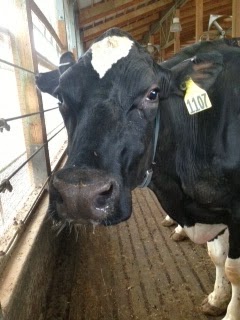
The dairy barn houses 185 happy Holsteins and seeing them up close was one of the highlights of our weekend. Let me tell you, as a city girl growing up 20 minutes west of NYC, these cows are BIG!
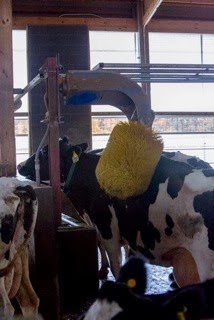
And they are treated like princesses – they can eat when and however much they like (their feed consists of a moist, fermented fodder made from corn, mixed with alfalfa, soy, canola oil, and grains). No straw beds for these girls; they bed down on sand, a much more comfortable cow mattress (being inorganic, it does not foster the growth of bacteria). The cows are never tied in place and when they get an itch, they mosey on over to the electronic back-scratching device (I kid you not). These are large, rounded nylon brush heads, and when a cow roams over to the machine, the brushes automatically start up and rub their back and flanks.

Automatic Cow Scratcher
So just how happy are these cows?  Well, I thought you’d never ask. Each cow produces an average of 95 pounds of milk per day! The dairy at Cornell is in the top 95th percentile of milk production. Nice, but what does that really mean?  The Cornell cows give so much milk that they are milked three times daily. To put this in perspective, most farms milk twice a day.

What does Cornell do with all that milk?  Half the milk stays on campus when school is in session and the rest goes to a regional dairy co-op.  But with all that good production, surely they must produce something besides milk, no?  Yes, indeed. We spent half of our visit in the Food Science lab (part of Cornell’s College of Agriculture and Life Sciences), learning how they partner with corporations like Chobani, Yancey’s Fancy, Murray’s Cheese, and others, training them on basic dairy sanitation, fluid milk production, yogurt and fermented products, and cheese production. 

Dairy Plant
Fresh Yogurt
The Dairy Plant is a 12,000 square foot facility equipped with the latest in automated dairy processing technology. Companies can partner with food science specialists to develop products in smaller, limited-run quantities. From an observational balcony, we had a bird’s-eye view of the path raw milk takes as it is transformed into ice cream, pasteurized milk, and yogurt. The dairy produces 1.5 million pounds of raw milk into fluid milk, yogurt, pudding, and 20,000 gallons of ice cream annually. 
Just-made Black Raspberry Ice Cream

In addition to producing fluid milk, yogurt, and ice cream products sold on the Cornell Ithaca campus, the Dairy Plant serves as a training facility for Cornell students, NY State Department of Agriculture and Dairy Inspectors, FDA Dairy Specialists, and NY State dairy plant managers. 

We got the opportunity to sample freshly made ice cream, yogurt, and the university’s pride and joy, Cornell Big Red Cheddar.  We also learned from Cornell’s yogurt gurus, the difference between good and bad yogurt (there’s more to this than you might think), and the five types of yogurt – cup set, stirred (Swiss style), drinking, frozen, and Greek.  Before this weekend, I had never sampled freshly made yogurt. I’ve eaten my share of high-end supermarket Greek yogurt, but this was a revelation. Full of just-milked flavor, smooth, and delicious, if I lived near Cornell, this is where I’d be getting my yogurt. Not to mention, my cheddar supply.


As our tour was ending, I ran to the campus store to buy a wheel of Big Red (I was not leaving without it!).  This is what cheddar cheese should taste like. Alas, it is only sold on campus, so I am hoarding my wheel, sharing it with a few cheese-worthy friends.


Speaking of cheese, Cornell has partnered with Wegmans to highlight and import NY State and US cheeses for their stores. With Cornell’s guidance, Wegmans is building its first affinage (cheese cave) facility in Rochester – a 10,000 SF facility to age its own cheeses. In addition, Wegmans hired an affineur to manage the caves. This is a prime example of the kind of partnerships Cornell’s Agriculture school is focused on. They are working with Wegmans to create a cheese-making curriculum focused on both basic and advanced skills as well as developing standard operating procedures to ensure the highest level of food safety and quality assurance.  Participating in the first-phase of the pilot program are Keeley’s Cheese Co., Danascara Artisan Cheese, Sprout Creek Farm, Goats & Gourmets, and Old Chatham Sheepherding Co. Cornell is looking for 3-5 more cheese artisans to meet with Wegmans for the next phase of the program.

Dairy farms in New Jersey are doing some pretty progressive things, too.  One example is the Fulper Family Farmstead in Lambertville. A fifth generation family farm, they are paving the way for greener dairy farm practices, including renewable solar energy, soil conservation methods, and nutrient recycling to ensure they are producing a sustainable product.

The family recently began producing Greek yogurt and mozzarella that they sell to restaurants and offer for pickup or at local farmer's markets.  The Lambertville area is a great destination for a road trip, and the Fulper Farm offers a variety of agritourism options, such as farm tours and summer camp.
 
Seneca Lake
Our base camp for the weekend was the beautiful Geneva on the Lake resort. The hotel, built in 1914, was based on villas in Florence, Italy. It sits on acres of rolling lawns and English style gardens overlooking Seneca Lake. We were there just past harvest, but this area is on my list for next September/October to enjoy the fall foliage and the vineyards up and down Rt 14. Many vineyards in the area specialize in Riesling, one of my favorites.

The weekend in the Finger Lakes was a fascinating peek into the “cow to consumer” process. Cornell is leading the pack by helping dairy farmers produce a better product, developing higher food safety standards, and most of all, putting cow comfort and health at the forefront of everything they do. Sounds like a win-win for everybody.  Think about it the next time you stand in front of the dairy case at your local market.